


By William D. Gibson, President & CEO, Boys & Girls Clubs of the Greater Triad
Last Friday morning, along with Winston-Salem Advisory Council member Jeff Brown, I sat in a room at Forsyth Tech’s Robert L. Strickland Center filled with people who don’t often get to sit at the same table: law enforcement, educators, judges, nonprofit leaders, faith and civic voices, and neighbors who simply care about kids. Leadership Winston-Salem brought us together for The State of Our Youth: A Community Conversation, and I left with pages of notes and a clear sense of urgency.
Katherine Perry, Executive Director of Leadership Winston-Salem, opened the morning by inviting us to listen, learn, and consider the role each of us can play in helping young people succeed. Then she welcomed Winston-Salem Police Chief William Penn, and his remarks set the tone for everything that followed. This wasn’t a briefing. It was a plea for help from the village. Chief Penn asked us to come together for the greater good of our young people, because no single agency, badge, or program can carry this alone. I put a star next to his name in my notes. That plea deserves an answer.
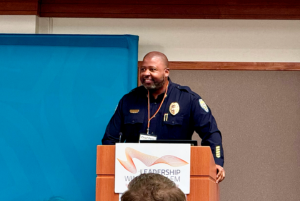
Winston-Salem Chief of Police, William H. Penn, Jr., speaking at the event.
For us, that call carries history. In the summer of 2025, as we began our initial listening and stakeholder meetings in Winston-Salem, Lt. Joel Morissette coordinated a meeting of police chiefs from across the Triad, hosted by Chief Penn, with Chief Cheeks of High Point and Chief Thompson of Greensboro before he retired, along with public communications officers. Since then, I’ve kept Lt. Morissette in the loop as we formed our Winston-Salem Advisory Council, and we’ve stayed connected to law enforcement and developments across the city. We’ve met with City Manager Pat Pate, who connected us to Assistant City Manager Ben Rowe, who has been instrumental and also serves on our Winston-Salem Advisory Council alongside City Councilman Robert Clark. Through all of it, we’ve spent time in the community listening to parents and teens, then building trust and programming around what they told us.
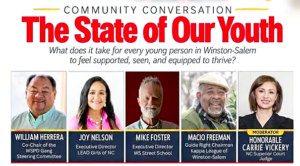
Superior Court Judge Carrie Vickery moderated a panel with Joy Nelson-Thomas of LEAD Girls of North Carolina, Macio Freeman of the Kappa League of Winston-Salem, William Herrera of the Winston-Salem Police Department’s Gang Steering Committee, and Mike Foster of the Winston-Salem Street School. What they described was honest and, at times, hard to hear.
I was especially glad to finally meet Mike Foster. Mark Doughton, who serves on the Street School board and has been an enthusiastic supporter of our work, had been encouraging that connection since we met at the State of the Economy event this summer. Mike and I are now planning a visit to the Street School to talk about intentional collaboration.
The challenges are layered. Housing instability. Poverty. Bullying and social isolation. Families living with the daily stress of possible separation through immigration enforcement. Young people growing up surrounded by violence. And at the center of it all, the number one issue named in the room: mental health. When those pressures stack up on a young person with nowhere safe to set them down, it shows up as erratic behavior in classrooms, in neighborhoods, and too often in the juvenile justice system. Behavior is communication. The question is whether we’re listening.
That word, listening, came up again and again. Panelists stressed the importance of listening to youth, not just designing programs for them. They talked about the need for real role models, and warned that the “wannabes” can be the most dangerous influences in a young person’s life. They talked about exposure, because kids can’t aspire to careers or colleges they’ve never seen. And they talked about relationships built on trust, which only get built one way: over time.
The moment that stayed with me most was the conversation about the transition from 5th to 6th grade. Panelists named it as the most challenging transition young people face, the move into middle school and into the teen years. And when the conversation turned to gangs, which are a real issue here, that same window surfaced again. It starts in middle school.
That’s where I want to push all of us. If gangs are an issue here, what does the actual data show? Where, when, and how are young people being pulled in? If it begins in middle school, then our response has to begin before it, at 10, 11, and 12 years old, when a trusted adult, a safe place, and a real sense of belonging can still change a young person’s trajectory. Gangs offer identity, protection, and family. Our job is to offer something better, and to offer it earlier.
This is exactly why our Minnie Lee Davis Harris Club matters.
On September 8, we launched full-time after-school programming at the Minnie Lee Davis Harris Club at 2020 E. 14th Street, BGCTriad’s seventh Club site and a dedicated Teen Center, in partnership with Winston-Salem Parks & Recreation. The energy and momentum have been unmistakable. We’ve been intentionally connecting Winston-Salem teens with our teens at the Congdon Hub in High Point, holding combined events at both Clubs and introducing them to the Keystone Club experience. They’re getting a preview of what their own Teen Center will become, from e-sports to recording studios and content creation. That’s exposure in action.
And there’s more coming. Through a partnership facilitated by the City and Ben Rowe, NASCAR’s Racing with Rajah program is projected for Minnie Lee at the first of the year, bringing interactive STEM and motorsports education centered on workforce development. Underneath all of it is the slow, unglamorous work the panel described, and our Club Director, JaQuon Moore, leads it every day: learning names, earning trust, and showing up consistently. JaQuon has already built strong relationships with our feeder schools and with parents and caregivers, so the trust doesn’t stop at the Club’s front door. That is how a building becomes a place where young people belong.
Minnie Lee is only the beginning. The trust we’ve built with the City, law enforcement, partners, and most of all with parents and teens is shaping the two more Clubs we plan to open in Winston-Salem this fiscal year as part of Future Ready Triad. Each new Club adds a link to what the room called for: a continuum of services that supports youth and families from childhood through the teen years, with academic support, mentoring, and career and college exposure along the way. Education is the pathway to economic mobility, and a Club is where that pathway becomes visible for kids who have never seen it.
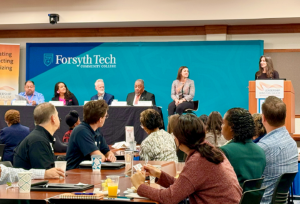 Before the morning ended, Joy Nelson-Thomas, Executive Director of LEAD Girls of North Carolina, asked a question every leader in that room needed to hear: “How are we leveraging our circles of influence?”
I haven’t stopped thinking about it, and it led me to two more questions of my own. Who are we opening doors for? Who are we encouraging? Each of us holds influence that could change a young person’s life: an internship, an introduction, a word of encouragement at exactly the right moment. What matters is whether we’re spending it on the kids who need it most.
The final charge was simple and challenging: set egos aside. Work together, not in silos. That one hits home for me, because it sits at the center of how we approach this work. It truly takes a village, and no single organization, including ours, will be able to serve every young person who needs us. Winston-Salem has no shortage of committed organizations and good people already doing this work well. What we need is alignment: partnering, collaborating, and coordinating so we close the gaps in the net of support around teens, youth, and families. That means shared data, shared goals, warm handoffs between programs, and a willingness to let the mission matter more than the logo on the door. Boys & Girls Clubs of the Greater Triad is committed to being that kind of partner, and I’m personally committed to building those relationships one conversation at a time.
As the morning closed, Leadership Winston-Salem announced the next conversation: a virtual webinar on January 27. I’ll be there, and I hope you will be too.
To Katherine Perry and the Leadership Winston-Salem team, Chief Penn, Judge Vickery, and every panelist: thank you for creating space for an honest conversation. Now comes the harder part: answering the plea.
The village has been called. Let’s show up.
To visit the Minnie Lee Davis Harris Club, volunteer, or invest in opening new Clubs in Winston-Salem, connect with us at bgctriad.org.
Rise. Belong. Become.