


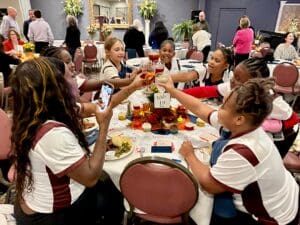
By Dr. William D. Gibson, President & CEO, Boys & Girls Clubs of the Greater Triad
A year ago, I walked through the door of what was then Boys & Girls Clubs of Greater High Point with a clear-eyed sense of the work ahead, and still managed to underestimate it.
That’s not a complaint. That’s just the honest truth that every leader who has stepped into an organizational improvement situation knows in their bones. You do your due diligence. You read the financials. You sit with the staff. You walk the sites. And then the door closes behind you, and the real work begins.
Twelve months later, I’m pausing. Not because the work is done—far from it—but because a year is a milestone worth marking with intentionality. And because the people around me deserve to hear it directly: I see you. I’m proud of you. And what you’ve done matters.
What we inherited. What we built.
Before I talk about what we’ve built this year, I want to name what was already here. Nearly 30 years of presence in High Point and Asheboro. Decades of Club Kids who grew up inside these walls, staff who showed up year after year, and a community that believed in this mission long before I arrived. That foundation is not a footnote to this expansion; it is the reason the expansion is possible. Future Ready Triad is not being built from scratch. It is being built on something real, something proven, and something that the Greater High Point and Asheboro communities can rightly claim as theirs. They are not following this movement. In a very real sense, they are leading it.
The challenges we walked into a year ago are not unique to this organization. Any leader who has stepped into a nonprofit in transition will recognize the landscape: a funding model too dependent on a single revenue source, governance muscles that hadn’t been fully exercised, a staff culture carrying the fatigue of uncertainty, and a development infrastructure that needed rebuilding rather than simply refreshing. These are common nonprofit realities. They don’t make the work easier, but they do make it recognizable. And recognizable problems have solutions.
What mattered most was the willingness to name them honestly, move quickly, and build something durable in their place.
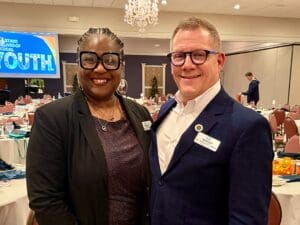
With Tam Campbell, Executive Vice President & Chief Operating Officer.
In twelve months, we restructured the organization from the ground up. We rebuilt financial infrastructure and internal controls. I brought in Tam Campbell as a trusted executive partner (I couldn’t have made it without her) and, after a lengthy search, hired Ray Trapp to lead our advancement strategy at a level required to support an ambitious expansion. Together with Heather Brock and Michael Henry—who were already here and rose to meet this moment—we built an executive team ready to lead, not just fill seats.
That team was forged in part through a deliberate process: existing leaders across the organization, including Club Directors and key staff, went through a rigorous reinterview built around a substantive assignment designed to surface the best of what each person had to offer. Some people found their footing through that process. Others found clarity about a different path. Both outcomes were right.
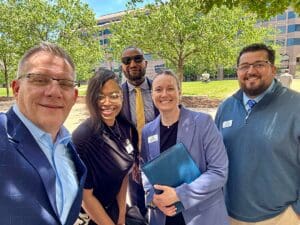
(L to R) Nadia Obiesie, Ray Trapp, Heather Brock, and Jonathan Flores on Advocacy Day in Raleigh, NC.
But the rebuild didn’t stop at the executive level. We reconstructed the entire leadership architecture—giving Club Directors a genuine seat at the table and real agency in shaping the direction of this organization for the first time. We raised the bar on leadership at every level, because our young people deserve the best we can bring, not what’s merely convenient or familiar. And we made a deliberate commitment to invest more in our frontline staff—the people who show up every day and make the Club experience real for kids. That investment isn’t a line item. It’s a statement of values.
We launched Future Ready Triad, now the largest active expansion initiative in Boys & Girls Clubs of America nationally, with a roadmap from 6 sites to 25–30 sites serving 9,000+ young people by 2030. We activated advisory councils across the region. We launched a campaign tracking upwards of $9 million between Greensboro and Winston-Salem alone. And we fundamentally shifted our funding philosophy from dependency to relationship.
None of that work happens without friction. Significant change—by its very nature—generates organizational anxiety. That’s not a sign that something is wrong. It’s a sign that something is moving. The real leadership test isn’t whether anxiety shows up. It’s whether you can hold the tension, keep people grounded in the mission, and maintain enough trust to keep the movement intact while the foundation is still being poured.
That’s what this year demanded. And that’s what this team delivered.
To our board: thank you for muddling through.
I mean that as high praise.
Change at this pace inside a nonprofit—especially one with deep roots in a community—generates anxiety. That’s not a character flaw; it’s the natural response to having the ground shift beneath you, repeatedly, in a short window of time. Our board didn’t always have perfect information. They didn’t always have the luxury of time. And they were asked to trust a new leader and a new direction while still processing the weight of what we had to correct.
They showed up anyway. They asked hard questions, and they sat with uncomfortable answers. They leaned into governance when governance wasn’t comfortable. That kind of institutional courage is not flashy, but it is foundational. I’m genuinely grateful for it.
One of the threads I keep coming back to at the end of this first year is that growth is a shared obligation. Not just organizational growth—personal growth. The willingness to be stretched. To sit with discomfort long enough to learn from it. To let the work change you, not just the other way around. I’ve watched board members do that this year in ways that genuinely moved me. I’ve tried to do it myself. And I think that commitment—to keep growing, keep stretching, keep showing up differently than we did before—is as important to this movement as any site we open or dollar we raise.
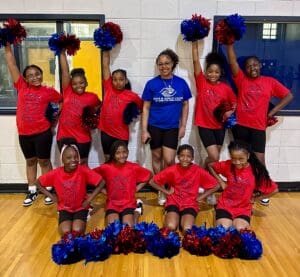
One of our many Cheer Teams!
For the young people who need us most.
I don’t write any of this to celebrate the organization. I write it to keep the center of gravity where it belongs: on the kids.
We are doing this work in a season when young people are navigating pressures that didn’t exist in the same form even a decade ago—economic instability, fractured social trust, the lingering trauma of a pandemic, the ever-present noise of a world that often seems indifferent to their futures. The absence of access to safe, structured, high-quality after-school programming is not a minor inconvenience. For too many young people in the Greater Triad, it is a defining disadvantage.
And then… there are the young people we lost.
Erubey Romero Medina. Daniel Jimenez Millian. Seventeen and sixteen years old. Gone at Leinbach Park in Winston-Salem on a Monday morning in April. I won’t pretend I have the right words for that grief—no one does. What I know is that their names deserve to be spoken, not just their tragedy. And Winston-Salem, a community that has been carrying this kind of weight for far too long, deserves leaders who don’t look away.
Their absence should make us more urgent, not less. Every site we open, every teen we keep engaged, every Club Kid who finds belonging and a path forward—that is the answer we can give. Not the only answer. But ours.
This is why the work cannot wait.
A word on the pace — and on myself.
I’m tired. I’ll say that plainly, because I think leaders have a responsibility to be honest about what this kind of work demands—especially when they’re asking everyone around them to carry something heavy.
Leading an organization through significant improvement, preparation, and simultaneous expansion, while stewarding a team, managing a board, developing advisory councils, cultivating funders, and staying present to the mission—it doesn’t leave a lot of margin. I’m aware of that tiredness. I’m tending to it. And I’m saying it out loud because the leaders on my team deserve to know that I see the weight they’re carrying too, and that I don’t take it for granted.
Sustainable leadership requires sustainable leaders. That’s not just a line in a strategic plan. It’s something I have to live.
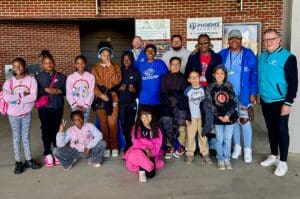
A trip with some of our Forest Hills Club Kids to a Carolina Core FC Match.
Year Two starts now.
Year two of this chapter marks my 27th year in nonprofit management, following over a decade as a marketing and branding entrepreneur. I’ve learned enough over those decades to know that the hardest seasons are rarely wasted ones. This one certainly hasn’t been.
New clubs are opening in Greensboro and Winston-Salem this summer. A governance model maturing in real time. A campaign gaining momentum. A leadership team that has been tested and is still standing—stronger, honestly, for what we’ve been through.
I’m proud. I’m tired. I’m grateful. And I’m not done.
For every young person in the Greater Triad who deserves a safe place, a great mentor, and a fighting chance at a future they can see clearly—we are building this for you.
Dr. William D. Gibson is the President & CEO of Boys & Girls Clubs of the Greater Triad and a Club Kid alum, Marine Corps veteran, and first-generation college graduate. He lives and leads in the Greater Triad region of North Carolina.