


When the Movement Comes Home: Reflections from the BGCA National Conference in Charlotte
By Dr. William D. Gibson, President & CEO, Boys & Girls Clubs of the Greater Triad

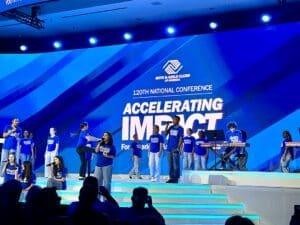
The 120th National Conference was held at the Charlotte Convention Center
There’s something that happens when you step out of the day-to-day and into a room full of people who are fighting the same fight you are. The noise of deadlines and decisions fades, and what comes rushing back is why—why this work matters, why it’s worth every late night and early morning, why we keep going.
That’s what Charlotte gave us this past week. It was important for our team.
For the first time in the 165-year history of Boys & Girls Clubs of America (BGCA), the National Conference landed in North Carolina for the 120th annual celebration. Right here. In our backyard. And for a team that is in the middle of the most ambitious expansion efforts in our organization’s history—and the largest nationally for BGCA—there was something deeply symbolic about that. The Movement came to us, and we showed up ready.
Why We Went
I want to be honest about something: conferences are easy to de-prioritize. There’s always a grant deadline, dozens of meetings, and a staff issue that feels more urgent. I’ve seen organizations pull back from gatherings like this and quietly convince themselves they can’t afford the time or the investment. I’ve never believed that, and Charlotte reminded me exactly why.
The BGCA National Conference is not a retreat. It’s a forcing function that demands 10 to 14-hour days of engagement. It became one of the few spaces where our newly configured leadership team was removed from the daily operating environment, placed in proximity to some of the sharpest organizational minds in the youth development sector, and given the room to think, learn, and lead at a higher level. You can’t build a movement from inside a building. You have to get out, look around, and come back with fire.
So we went. And we went deep.

(L to R), William Gibson, Tamara Campbell, Tom Schaaf, Michael Henry, Ray Trapp, Heather Brock, Nadia Obiesie, and Kierra Currie
Our Team, In the Room
Representing Boys & Girls Clubs of the Greater Triad (BGCTriad) were Executive Vice President & COO Tam Campbell, Vice President of Advancement Ray Trapp, Vice President of Programs & Impact Heather Brock, Vice President of Safety & Sites Michael Henry, Interim Supervising Club Director Nadia Obiesie, Athletics Director Kierra Currie, and me. Joining us from our board were Regional Board Members Tom Schaaf and Quinton Louris—who also serves as Chairperson of our Asheboro Advisory Council—along with Asheboro Advisory Council Member Gene Woodle.
That kind of representation matters. When your board members and your frontline leadership are sitting in the same sessions, absorbing the same ideas, and building relationships with Club professionals from across the country, it creates alignment that no internal planning retreat can replicate. That’s organizational development in real time.
Setting the Tone
BGCA President & CEO Jim Clark opened the conference with a powerful reminder of the scale of what we’re building together, sharing that Boys & Girls Clubs across the country served a record-breaking 4 million young people. Four million. Let that sit for a moment. That’s not a statistic. That’s a generation in motion.
The youth talent performances woven throughout the conference were, frankly, over the top. Every time those young people took the stage, they reminded every adult in the room what this is actually about. You can talk strategy and data and growth trajectories all day, but nothing recalibrates your soul like watching a Club kid perform with confidence, precision, and joy. That’s the product. That’s the proof.
Voices That Demanded Attention
The conference drew some remarkable voices this year — and I mean that across every dimension. Intellectual. Artistic. Visionary.
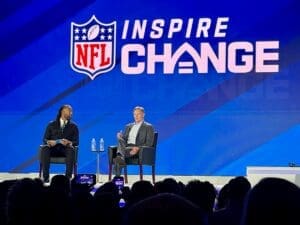
Larry Fitzgerald and Roger Goodell
Larry Fitzgerald—BGCA Board of Governors member, philanthropist, and one of the most decorated wide receivers to ever play the game—brought his trademark blend of purpose and professionalism to the stage. NFL Commissioner Roger Goodell joined as well, underscoring what the NFL-BGCA partnership represents: not just a sponsorship, but a shared commitment to giving young people a fighting chance. When the Commissioner of the world’s most powerful sports league is in your room, talking about youth development, it speaks to the credibility and reach of this Movement.
Dr. Angela Duckworth—MacArthur Fellow and pioneering researcher behind Grit: The Power of Passion and Perseverance—brought her foundational research to life in a way that was both rigorous and deeply personal, reminding us that the kids we serve don’t just need programs—they need environments that build the grit to go the distance. Sinead Bovell—futurist, strategist, and widely known as the “AI Educator for Non-Nerds”—challenged the room to think boldly about what’s coming and who gets left behind if we don’t prepare young people for it. Her perspective felt less like a keynote and more like a warning shot: the future is not waiting, and our kids can’t afford to have us behind it.
And then there was Bradley Rapier—Emmy-nominated choreographer, speaker, and founder of Groove Theory—whose monologue performance stopped the room cold. He didn’t just speak to the audience. He activated us. And when the youth talent performers joined him on stage at the close of his dance portion, the energy was nothing short of phenomenal—a full-circle moment that only Boys & Girls Clubs can produce.
BGCTriad on the National Stage
I’ll be honest—I was proud. Not in a self-congratulatory way, but in the way that happens when your team’s work gets recognized by peers who understand exactly how hard the climb is.
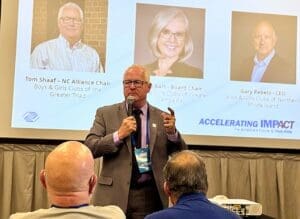
BGCTriad Board Member, Tom Schaaf, speaking at the conference
Our Future Ready Triad expansion was highlighted at the conference, and our own Tom Schaaf represented us exceptionally well as a panelist on the Governing for Growth: Board-Level Strategies That Balance Bold Vision and Smart Risk panel. Tom brought the kind of grounded, strategic perspective that only comes from someone who has been a true partner in building something—not just advising from a distance. He was outstanding, and the session generated real conversation. That’s what happens when you come with substance.
The recognition extended beyond sessions and panels. I had the privilege of sharing dinner one evening with President & CEO Jim Clark—a conversation that reinforced what we already believed: the work happening in the Triad has national attention. Jim leads this Movement with both vision and genuine relational investment in the organizations doing the hard work on the ground. That kind of access and connection doesn’t happen by accident. It happens when you show up, do the work, and let the results speak.
Learning That Moved Me
Every breakout session I attended had something to offer, but one stands out: 12 Second Culture, presented by NASCAR. Delivered by Mike Metcalf Jr.—a National Award-Winning Pit Crew Coach and team leader—this session drew on the world of pit crew performance to break down everything we think we know about team dynamics, execution under pressure, and the culture that makes peak performance possible.
Twelve seconds. That’s how long a NASCAR pit crew has to change four tires, fuel a car, and send a driver back onto the track. Twelve seconds that can win or lose a race. Metcalf’s insight wasn’t just about speed; it was about trust, accountability, repetition, and the invisible architecture of a high-functioning team. I left that session thinking about our own staff, our Club Directors, our program leads. How do we build a 12-second culture? How do we create the conditions where every person knows their role so well that they execute without hesitation, and then do it again, and again, at scale?
That’s the kind of question that only emerges when you’re in the right room.
Other breakout conversations ranged from safety and data-driven impact measurement and sustainable funding strategies to workforce readiness programming and the future of Club expansion—all critical threads as we build out Future Ready Triad across the region.

The 2026 Alumni Hall of Fame inductees
The Alumni Hall of Fame: Stories That Stay With You
Two nights before the conference closed, we gathered for the Alumni Hall of Fame Induction Ceremony—an evening set apart, dedicated entirely to the inductees and the stories that brought them to that stage. The ceremony was hosted by Emmy Award-winning actor Courtney B. Vance, himself a proud Club Kid and a 2005 Alumni Hall of Fame inductee.
The 2026 inductees spanned racetracks, recording studios, boardrooms, and football fields—and every one of them started as a kid at a Club. This year’s class included NASCAR Cup Series driver Bubba Wallace; recording artist and philanthropist Sean “Big Sean” Anderson; Pro Football Hall of Famer and Super Bowl champion DeMarcus Ware; NFL player Dion Dawkins; financial journalist and television host Charles Payne; and actor and producer Martin Sensmeier—along with Kim Keck, President & CEO of Blue Cross Blue Shield Association, whose distinguished career in healthcare leadership traces back to her days as a Club Kid.
What struck me most wasn’t the fame. It was the throughline. Every inductee, in their own way, told a version of the same story: the Club saw something in me before I saw it in myself. That’s our work. That’s what we do in High Point and Asheboro every single day, and what we will be doing in Greensboro, Winston-Salem, and across the Greater Triad region. We see kids before the world has decided what they’re worth, and we invest accordingly.
As a Club Kid myself, those moments weren’t abstract. They were personal. They were a reminder that the kid you invest in today may stand on a stage like that one day—and your belief in them will have been part of what got them there.
The Gala: Celebrating the Work Across the Movement
The conference closed on its final night with a Gala—a celebration of clubs and individuals from across the country who have demonstrated extraordinary achievement and impact in the work. It was a fitting close to a week that demanded a lot from everyone in that room. Long days. Full rooms. Ideas that refused to stop coming. The Gala gave us a chance to exhale together, honor the people doing the work, and walk away reminded that this Movement is bigger than any one organization—and better because of all of us.
What We’re Carrying Back
We came back from Charlotte sharper. More connected. More certain that what we’re building here in the Triad is not just a regional story—it’s a national one.
The Future Ready Triad expansion—our bold vision to grow from 6 clubs to 25–30 sites serving 9,000+ young people by 2030—resonated with Club professionals from across the country. We’re not just growing. We’re building a model. And the national conference reminded us that the Movement is watching, rooting for us, and ready to learn alongside us.
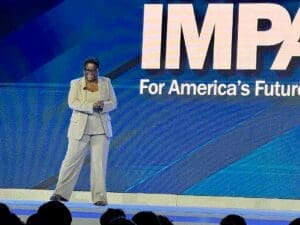
Lorraine Orr, BGCA Executive Vice President & Chief Operating Officer
Lorraine Orr, Executive Vice President & Chief Operating Officer for BGCA, closed the final session with words that hit differently than a typical conference send-off. She said: “We cannot leave this place inspired but go home unchanged.” Those words carry particular weight for us, because Lorraine isn’t just a national leader—she has a personal investment in seeing the Greater Triad succeed. Years ago, before her ascent to BGCA’s national leadership, she served as Executive Director of the Boys & Girls Clubs of Greensboro, which was then part of the Salvation Army. She knows this community. She knows what’s possible here. And her challenge to us wasn’t rhetorical—it was a charge.
We didn’t intend to go home unchanged.
We brought a full team to Charlotte—10 to 14 hours a day, every day—because great organizations invest in the people who make them great. It was long. It was demanding. And it was exactly what a newly restructured team needed (though we were not able to take our entire leadership team with us). There is something that happens when you grind alongside your people in a room that isn’t yours, far from the comfort of your own offices—something that no staff meeting or strategic planning session can manufacture. We came back tighter. More trusting. More aligned around a shared sense of mission and momentum.
And we came home ready to build.

(L to R) William Gibson, Gene Woodle, Kierra Currie, Heather Brock, Nadia Obiesie, and Quinton Louris

William Gibson, Tamara Campbell, and Jim Clark